
TMJ Treatment: Beyond Basic Jaw Exercises
If jaw stretches from the internet haven't fixed your TMJ pain, you're not out of options — you're missing the layers a complete treatment addresses.
Santosh Singh
Registered Physiotherapist / Director
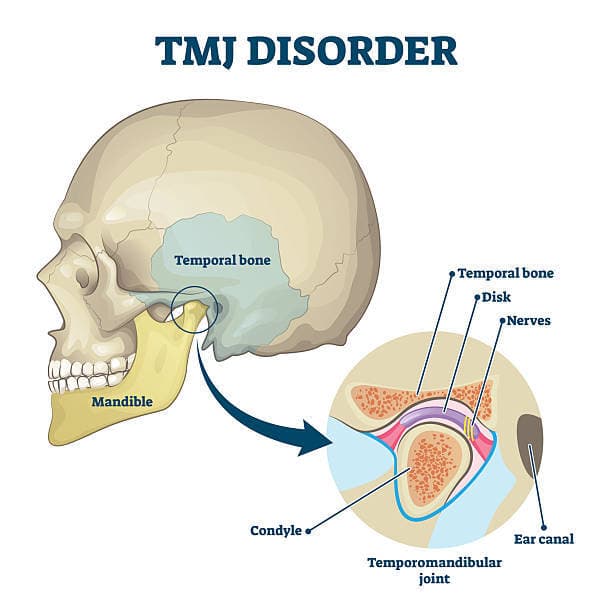
Search "TMJ exercises" and you'll find the same handful of jaw stretches everywhere. They help some people. But if you've done them faithfully and your jaw still clicks, aches, or locks — the problem isn't your effort. Basic exercises address one layer of a multi-layer system.
Layer 1: The joint itself
The TMJ contains a small cartilage disc that glides with every opening. When the joint is stiff or the disc tracks poorly, no amount of stretching fixes the mechanics — it needs specific joint mobilization: precise, graded techniques that restore glide and decompress irritated structures. This is skilled hands-on work, not a home exercise.
Layer 2: The muscles you can't reach
The masseter and temporalis respond somewhat to self-massage. But two of the most important jaw muscles — the medial and lateral pterygoids — sit where fingers don't usefully go from outside. Intra-oral release (gloved, brief, within tolerance) and dry needling of the deep jaw muscles reach what internet exercises structurally cannot.
Layer 3: The neck
The upper cervical spine and the jaw share neurology and mechanics; forward-head posture alone changes how the jaw rests and tracks. Persistent TMJ pain with an untreated stiff neck is a treatment plan with a hole in it. We assess and treat both, every time.
Layer 4: The habits driving it all
Night clenching, daytime jaw bracing during focus or stress, gum chewing, nail biting, one-sided chewing — these reload the system daily. Habit retraining (rest position: lips together, teeth apart, tongue on the palate), stress strategies, and coordination with your dentist on a night splint when indicated close the loop.
What a complete plan looks like
Assessment across all four layers, hands-on treatment of the restricted ones, a precise exercise program (controlled opening drills matched to your specific pattern — different from generic stretches), and habit work. Most patients feel significant change within four to six sessions, even after years of symptoms.
Our clinic director has specialized post-graduate training in TMJ rehabilitation. If your jaw has outlasted the basic exercises, book the complete assessment: 587-355-3555 — Nolan Hill Physiotherapy & Massage, NW Calgary.
Dealing with pain or an injury?
Our multidisciplinary team is here 7 days a week in Nolan Hill, NW Calgary — with direct billing to most insurers.
Call 587-355-3555Related Articles
More recovery insights from the Nolan Hill team
The Benefits of Physiotherapy for TMJ Disorders
Before considering splints alone or surgery, most jaw pain deserves a trial of physiotherapy. Here's what TMJ physio actually does — and the results patients can expect.
Santosh Singh
Registered Physiotherapist / Director
Manual TMJ Therapy Techniques: A Look Inside Treatment
Manual TMJ Therapy Techniques: A Look Inside Treatment
What actually happens during hands-on TMJ treatment? A walkthrough of the manual therapy techniques physiotherapists use to release the jaw — inside and out.
Santosh Singh
Registered Physiotherapist / Director

Chronic Headache Relief Strategies
Many chronic headaches are driven from the neck and jaw — which means hands-on treatment can do what painkillers can't. A strategy guide for the headache-weary.
Santosh Singh
Registered Physiotherapist / Director